Journal
Singing Bowl Buyer's Guide — Seven metals, real heritage, B2B import basics
How to source authentic Himalayan singing bowls for retail or wellness wholesale: the seven-metal alloy, hand-hammered vs cast, tone matching, MOQs, and the customs tariff codes that actually matter.
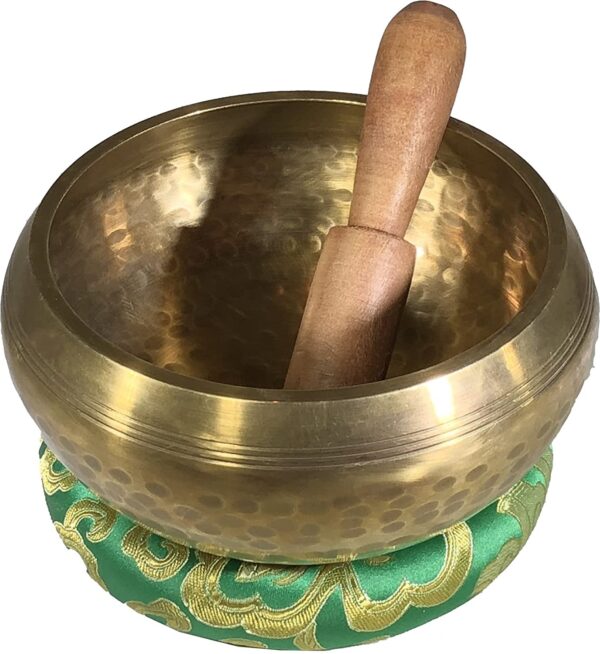
The singing bowl industry in Kathmandu is split into two clean halves. One half makes hand-hammered bowls from a traditional seven-metal alloy, tunes them by ear over a charcoal forge, and sells them to wellness retailers at US$80–US$320 wholesale. The other half mass-casts brass bowls in a Bhaktapur foundry, etches mantras with a CNC router, and drop-ships them to Amazon resellers at US$3 a unit.
Both are "Nepali singing bowls." Only one of them justifies the retail margin and the customer-experience story you probably want to tell. This guide is the brief we send first-time wellness importers to keep them out of the cheap-cast lane.
The seven metals — and why they matter
Authentic Himalayan singing bowls — the lineage that traces back to the forges of Patan and Bhaktapur — are forged from panchaloha or saptaloha, a traditional alloy of seven metals corresponding to seven planetary bodies in Buddhist-Tantric metallurgy:
- Gold (sun) — trace; raises pitch brightness
- Silver (moon) — trace; sustains overtone
- Copper (Venus) — primary; ~70% of the bowl
- Tin (Jupiter) — primary; ~25%, gives the alloy its hardness
- Iron (Mars) — small share; lowers fundamental
- Mercury (Mercury) — historical; phased out for safety
- Lead (Saturn) — historical; phased out for safety
Modern compliant bowls (post-2010, REACH and California Prop 65) use a gold/silver/copper/tin/iron blend with mercury and lead replaced by trace zinc and antimony. Any reputable workshop will hand you the alloy composition on request. If they can't, walk.
Hand-hammered vs sand-cast — how to tell at a glance
The single most important distinction in this category. Get it wrong and your wellness customer will return the bowl after one ceremony.
- Hand-hammered bowls show concentric ring marks across the inner surface — the trace of the smith working the metal cold after each forge cycle. The ring marks are slightly irregular: the same hand, but not the same blow. The bowl rim is a hair uneven.
- Sand-cast bowls are smooth inside, with a faint mould seam visible on the outer rim or base. The wall thickness is uniform to a tenth of a millimetre — too uniform. They produce a single resonant note that decays in 6–8 seconds.
- Cast then machined bowls add fake ring marks via a lathe. Look for the rings to be perfectly parallel and equally spaced. That's the giveaway.
A real hand-hammered bowl sustains its fundamental note for 25–60 seconds, with a complex overtone shimmer that shifts as you walk around it. That's what the customer is buying.
Tone matching for the wellness market
If your end-customer is a sound-therapy practitioner or a yoga studio, they want bowls tuned to specific chakra frequencies. The seven-bowl set is the standard SKU:
- Root chakra (C3) — 130.81 Hz
- Sacral chakra (D3) — 146.83 Hz
- Solar plexus (E3) — 164.81 Hz
- Heart chakra (F3) — 174.61 Hz
- Throat chakra (G3) — 196.00 Hz
- Third-eye (A3) — 220.00 Hz
- Crown chakra (B3) — 246.94 Hz
Workshops we work with tune to within ±3 Hz of these targets. Anything looser than that and a wellness practitioner will hear it. We test every bowl against a chromatic tuner before packing.
Sizing and shipping
Common size brackets and what they're used for:
- 3–4 inches — travel/altar bowls, retail US$25–60.
- 5–7 inches — meditation bowls, retail US$60–150.
- 8–10 inches — therapy session bowls, US$150–320.
- 11+ inches — group ceremony bowls, US$320–800.
Shipping is straightforward: bowls travel best in foam-lined wood crates with one bowl per cell. Air freight ex-Kathmandu to Bangkok is roughly US$8/kg; sea freight to Hamburg or Long Beach is US$1.40/kg with a 35–45 day transit. The relevant HS code is 7418.20.0030 ("brass household articles") in most jurisdictions; check your destination tariff before you commit MOQ.
What we ship
Our standard wholesale offering is hand-hammered seven-metal bowls in 5-inch, 7-inch, and 9-inch sizes, tone-matched to chakra targets, with a hardwood mallet and felt ring per bowl. MOQ starts at 24 pieces (a mixed sampler) and the lead time is 3–5 weeks for tone-matched orders.
For wellness retailers we also assemble curated 7-bowl chakra sets packed as a single SKU with practitioner notes — useful for boutique stores that don't want to stock the full size range.
Talk to us
If you're a wellness retailer, a yoga studio chain, or a gift-shop buyer figuring out your first container — message us on WhatsApp with your target retail tier and the chakra-set vs single-bowl mix you want. We'll come back with a sample-pack proposal you can A/B against whatever supplier you're currently considering.
Browse the singing bowl category or the full export catalogue.
Talk to a sourcing desk
Want a market-ready sample pack?
Send us your buyer profile and target retail tier on WhatsApp. We come back with a sample-pack proposal within 48 hours.
Inquire on WhatsApp